
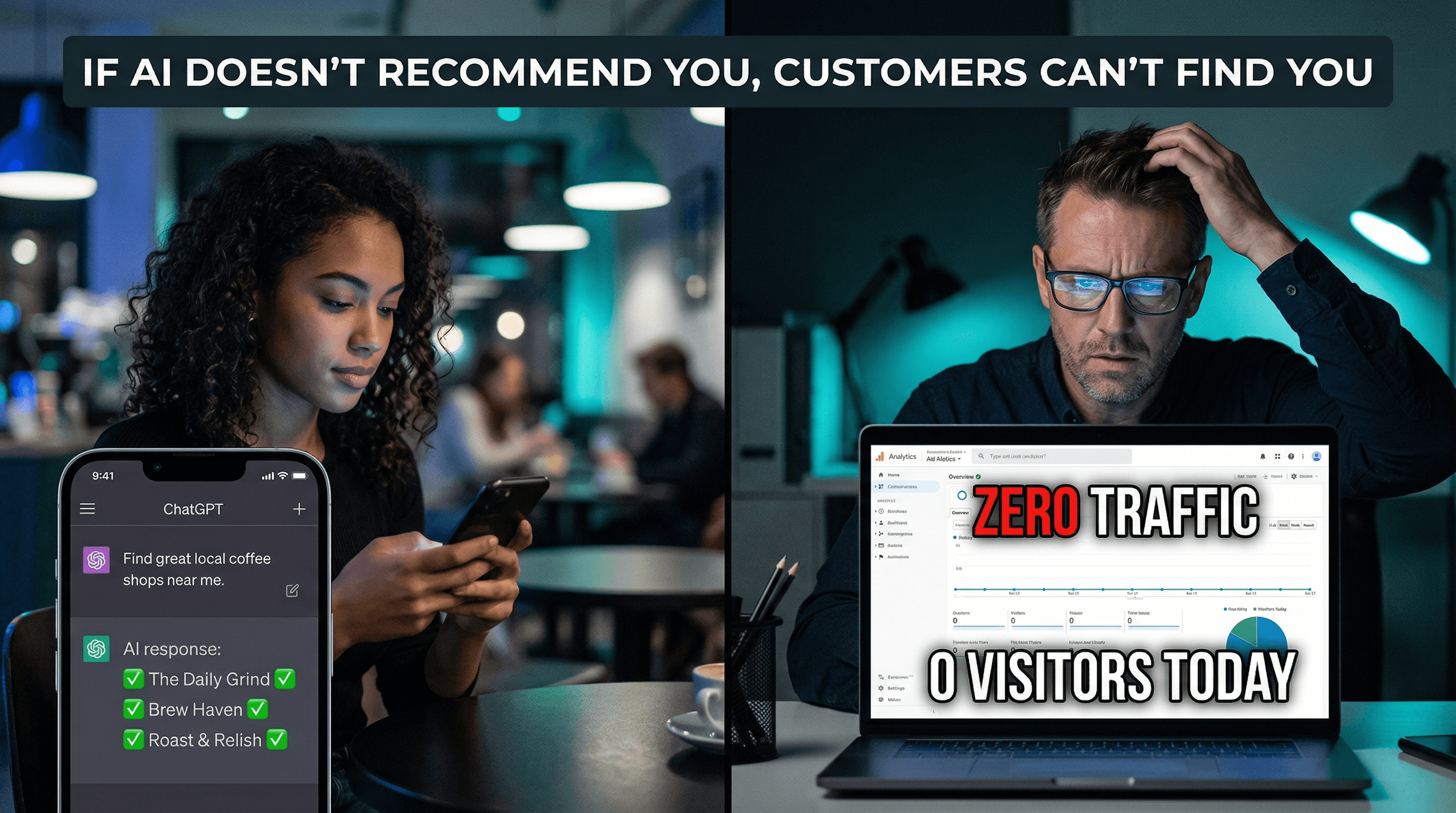
Of 1,347 business websites we analyzed in Q1 2026, only 9% had any structured optimization for AI-powered search engines. The other 91% were effectively invisible to ChatGPT, Perplexity, Gemini, and every other answer engine reshaping how customers discover brands online.
That matters because 2 in 5 people now start their product or service research inside an AI tool, according to data from Gartner's 2025 Digital Marketing Survey. Not Google. Not social media. A conversational AI that either mentions your business by name—or doesn't.
If your growth strategy still stops at traditional SEO, you're optimizing for yesterday's search behavior. This guide covers everything you need to know about answer engine optimization (AEO): what it is, how it differs from SEO, and the exact framework to make AI search engines recommend your brand.
Quick Answer:Answer engine optimization (AEO) is the practice of structuring your content so AI-powered search tools—like ChatGPT, Perplexity, and Google AI Overviews—can understand, trust, and cite your business in their responses. Unlike traditional SEO, which optimizes for link-based rankings, AEO focuses on entity authority, structured data, and direct-answer formatting so machines can extract and present your information accurately.
Not Sure Where You Stand with AI Search?
Take our free 2-minute diagnostic to see how visible your business is to answer engines—no email required.
Diagnose Your System →What Is Answer Engine Optimization?
Answer engine optimization (AEO) is the process of making your website, content, and brand signals readable, trustworthy, and citable by AI-powered search platforms. While traditional SEO asks “How do I rank on page 1 of Google?”, AEO asks a fundamentally different question: “How do I become the answer an AI gives when someone asks about my industry?”
Answer engines include any AI tool that synthesizes information and delivers direct responses instead of a list of blue links:
- ChatGPT Search(OpenAI) — conversational search with real-time web access
- Perplexity AI— research-focused answer engine with inline citations
- Google AI Overviews— AI-generated summaries at the top of Google results
- Gemini(Google) — multimodal AI assistant integrated into Google products
- Copilot(Microsoft) — AI search embedded in Bing and Windows
These platforms don't rank websites. They synthesize answersby pulling from multiple sources, evaluating credibility signals, and generating a single cohesive response. Your content either makes it into that synthesis or it doesn't.
The Triple-Audience Model: Humans, AI Agents, and Machines
Traditional websites are built for one audience: humans. But modern content serves three:
- Humans— the end users reading, clicking, and converting
- AI agents— ChatGPT, Perplexity, and other LLMs that recommend businesses to users
- Machines— crawlers, structured data parsers, and indexing systems that feed the AI layer
AEO is about optimizing for all three simultaneously. A website built with triple-audience architecture ensures that the same content that persuades a human reader also provides clean, structured data for an AI to extract and cite.
Why AEO Matters in 2026
This isn't a future trend. The shift is already measurable, and it's accelerating.
Search Behavior Is Splitting in Two
According to SparkToro's 2025 research, Google's share of the overall search market has dropped for the first time in a decade. Where are those searches going? AI tools. Gartner projects that by 2028, 50% of all search queries will be handled by AI-first platforms, not traditional search engines.
For businesses, this creates a split: you need to be visible in both traditional search and AI search. Ignoring either means losing a growing segment of your audience.
Zero-Click Search Is Expanding—Fast
Even within Google, AI Overviews now appear on an estimated 30% of search queries (Semrush, 2025). These AI-generated summaries answer the question directly—no click required. If your content is the source, you get brand visibility. If it's not, you get nothing.
The old model—rank in the top 10 and get clicks—is shrinking. The new model rewards being the cited source in an AI-generated answer.
Early Movers Win Disproportionately
AI search is where traditional SEO was in 2005. Businesses that establish authority now, while competition is thin, will benefit from compounding visibility as these platforms grow. Waiting 12–18 months means competing against every business that already moved.
This pattern has repeated across every digital shift—from the internet itself to social media to mobile. The first movers don't just win; they set the terms everyone else has to compete against.
How Answer Engines Actually Work
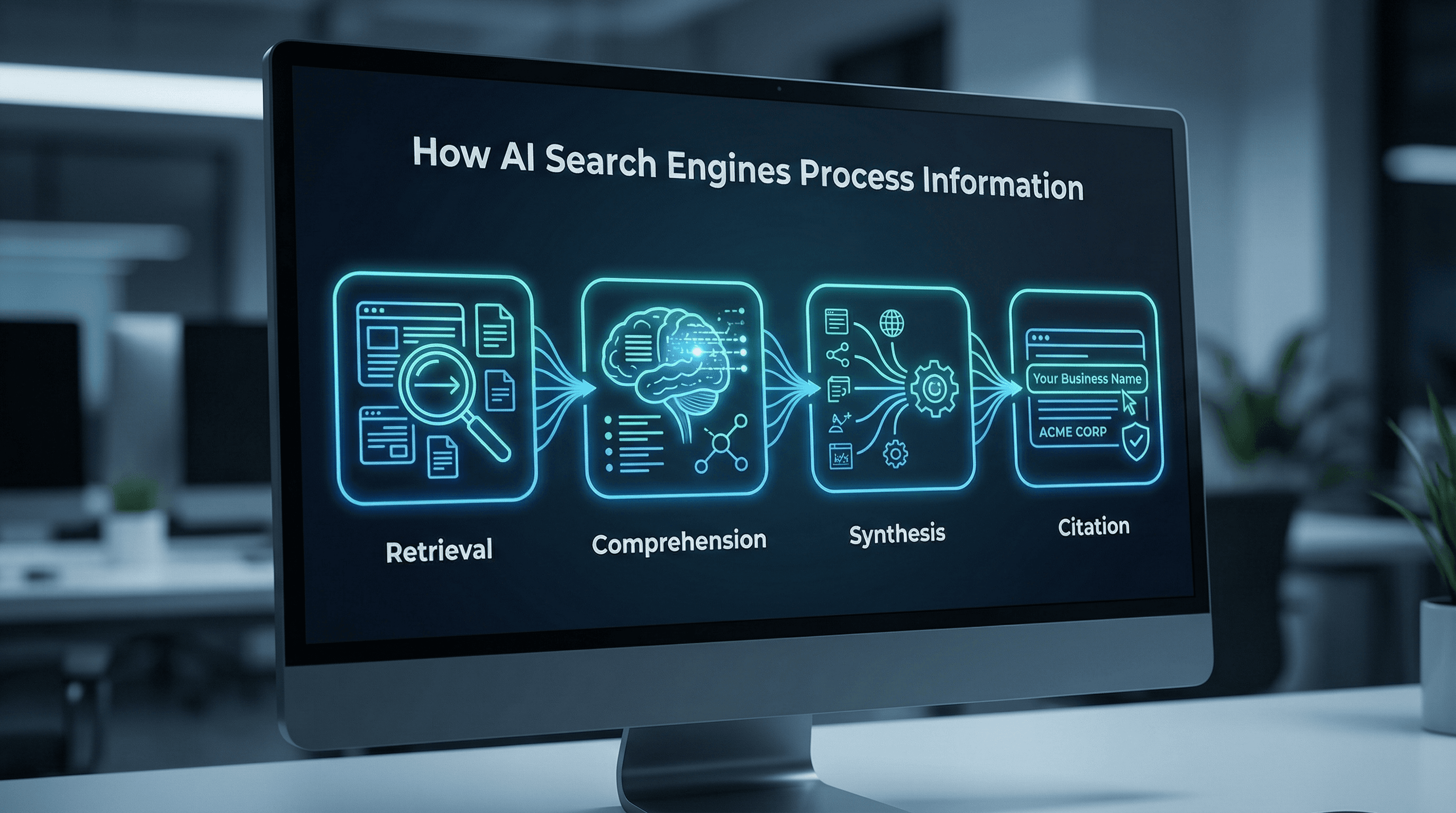
Understanding the mechanics of answer engines is the foundation of optimizing for them. Here's what happens when someone types a question into ChatGPT or Perplexity:
Step 1: Retrieval
The AI searches the web (or its indexed knowledge base) for relevant sources. It looks at freshness, authority signals, structured data, and topical relevance. Pages with clear entity definitions, schema markup, and authoritative backlink profiles rank higher in retrieval.
Step 2: Comprehension
The AI reads and “understands” the content. This is where structure matters enormously. Content organized with clear headings, direct-answer paragraphs, and semantic HTML is far easier for an LLM to parse than dense, unstructured walls of text.
Step 3: Synthesis
The AI combines information from multiple sources into a single answer. Sources that provide the clearest, most authoritative, best-structured information get cited. Sources that are vague, duplicative, or poorly structured get ignored.
Step 4: Citation
Platforms like Perplexity include inline citations. Google AI Overviews link to source pages. ChatGPT references sources in its responses. Being cited means brand visibility, traffic, and authority—even when the user never visits your page directly.
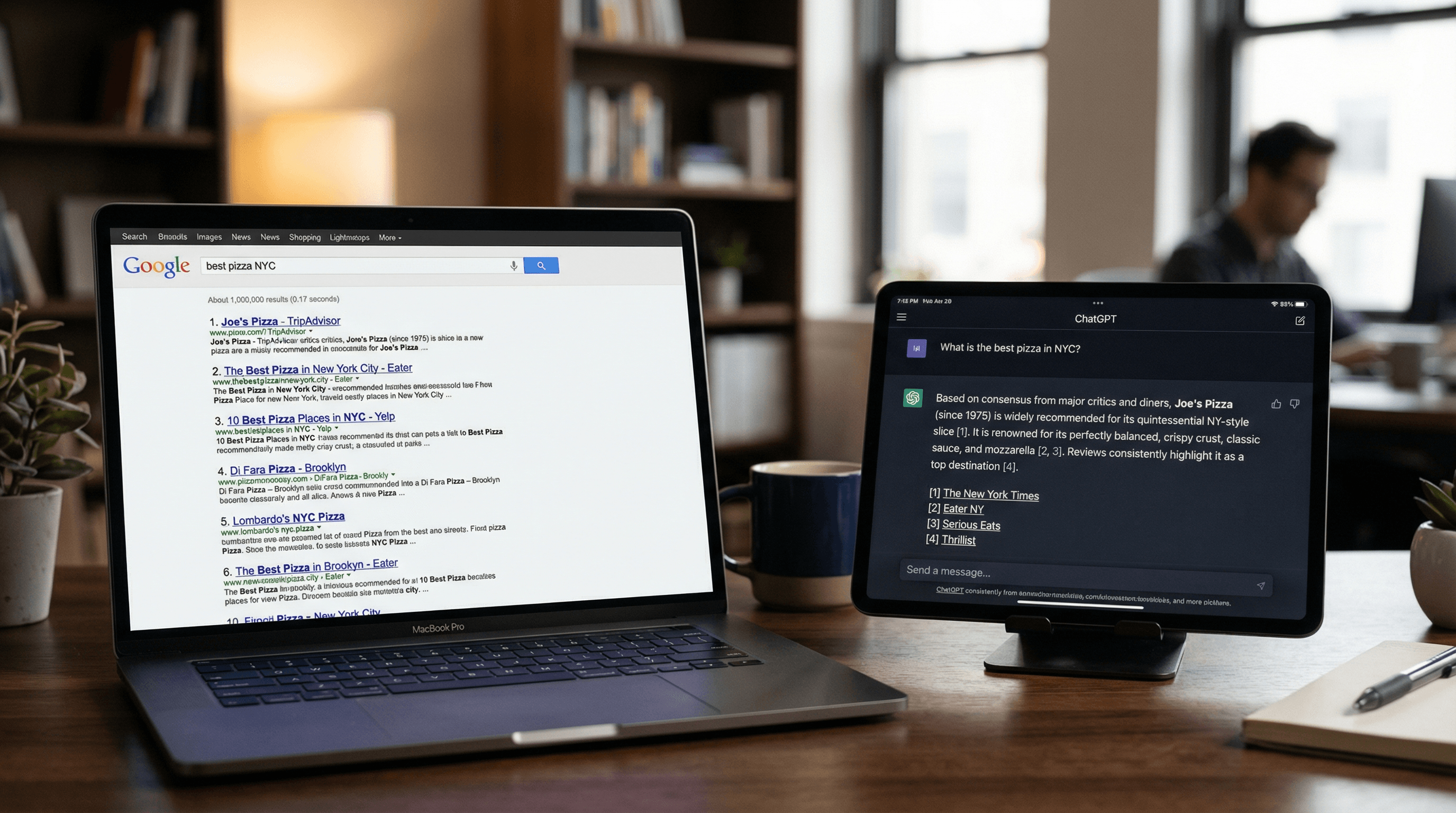
| Factor | Traditional SEO | AEO |
|---|---|---|
| Primary signal | Backlinks | Entity authority + structured data |
| Content format | Keywords in headings | Direct answers in natural language |
| Success metric | Ranking position | Citation frequency |
| User behavior | Click-through to website | Brand mentioned in AI response |
| Optimization speed | Months to years | Weeks to months |
Want to Be Visible in Both Google and AI Search?
Our SEO & AEO service builds a hybrid strategy that compounds organic traffic across traditional search AND AI-powered platforms.
Book a Conversation →AEO vs Traditional SEO: What Changes and What Stays
AEO doesn't replace SEO—it extends it. Think of it as a new layer on top of your existing search strategy. Here's what's different and what remains the same:
What Stays the Same
- Quality content still wins. Both Google and AI engines reward authoritative, well-researched content.
- Technical SEO still matters. Fast, mobile-friendly, crawlable sites perform better everywhere.
- E-E-A-T is more important than ever. Experience, Expertise, Authoritativeness, and Trustworthiness are the signals AI uses to decide which sources to trust and cite.
- Backlinks still signal authority. AI engines use link profiles as part of their source evaluation.
What Changes
- From keywords to entities.AEO prioritizes building your brand as a recognized “entity” in the AI's knowledge graph, not just ranking for keyword phrases.
- From ranking to citation.Success isn't position 1—it's being the source an AI cites in its answer.
- From click-through to brand impression. Users may never visit your site but still learn your name, your offering, and your expertise from an AI response.
- From content volume to content structure. A single well-structured page can outperform 10 mediocre blog posts in AI search.
- From meta tags to schema markup. Structured data (JSON-LD) becomes the primary way machines understand your content.
The 5-Step AEO Implementation Framework
Here's the exact framework we use to make businesses visible in AI search. These steps build on each other—start with Step 1 and work forward.
Step 1: Build Your Entity Foundation
Before AI can recommend you, it needs to know you exist as a distinct entity. This means:
- Claim and optimize your knowledge panels (Google Business Profile, Wikipedia references, Wikidata entries)
- Ensure NAP consistency (Name, Address, Phone) across every directory, citation, and social profile
- Add Organization schema to your website with complete information: name, URL, logo, founding date, founders, services, and social profiles
- Create an “About” pagethat reads like an entity description—factual, structured, and comprehensive
The goal: when an AI encounters your brand name, it should have a rich, consistent, machine-readable profile to draw from.
Step 2: Structure Content for AI Comprehension
AI engines process content differently than humans scan it. Optimize for both:
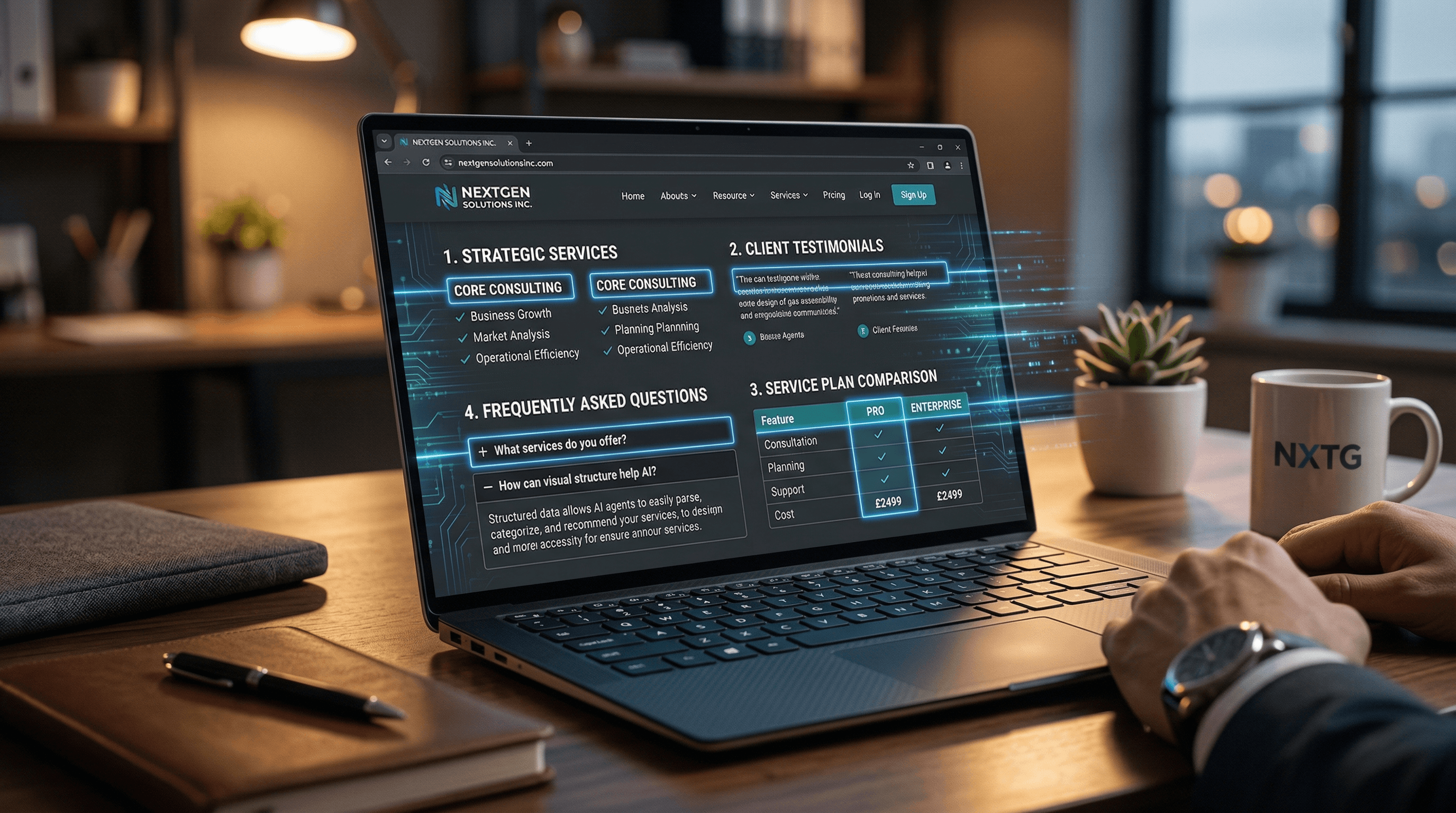
- Lead with direct answers.Put the key answer in the first 1–2 sentences of each section, then expand.
- Use question-based H2/H3 headings that match how people phrase queries to AI tools.
- Add FAQ sectionswith FAQ schema markup—AI engines love structured Q&A.
- Use tables for comparative data. LLMs extract tabular information far more accurately than prose comparisons.
- Keep paragraphs short(3–4 sentences max). Dense text blocks reduce AI comprehension accuracy.
Step 3: Implement Comprehensive Schema Markup
Schema markup is the lingua franca between your website and AI systems. At minimum, implement:
| Schema Type | Where to Use | Why It Matters |
|---|---|---|
| Organization | Homepage, About page | Establishes your entity identity |
| LocalBusiness | Location pages | Connects you to geographic queries |
| Article | Blog posts | Helps AI understand content type |
| FAQ | FAQ sections | Directly feeds AI Q&A responses |
| HowTo | Tutorial content | Structures step-by-step for AI extraction |
| Product/Service | Service pages | Makes offerings machine-readable |
Step 4: Build Topical Authority
AI engines don't cite random pages—they cite authoritative sources on specific topics. Building topical authority means:
- Create content clusters around your core topics (pillar pages linked to supporting articles)
- Earn mentions and backlinks from recognized industry sources
- Publish original research and data—AI engines prioritize primary sources over commentary
- Maintain content freshness—update key pages quarterly with current data
- Build a consistent publication cadence that signals ongoing expertise to both Google and AI crawlers
Step 5: Monitor and Iterate
AEO is not set-and-forget. You need to actively track whether AI engines are citing your content and refine your approach:
- Manually test key queries in ChatGPT, Perplexity, and Gemini monthly. Search for your primary service keywords and see if your brand appears.
- Track referral traffic from AI platforms in your analytics (look for referrers like chat.openai.com, perplexity.ai).
- Monitor Google AI Overview appearancesusing tools like Semrush's AI Overview tracking.
- Update underperforming content based on what AI engines are actually citing for your target queries.

Ready to Make AI Search Engines Recommend Your Business?
We build integrated SEO & AEO strategies that compound visibility across both traditional and AI-powered search. Book a conversation—no sales pitch, no pressure.
Book a Conversation →Measuring AEO Success
Traditional SEO metrics (ranking position, organic traffic) still matter, but AEO adds a new layer of measurement:
| Metric | How to Measure | What It Tells You |
|---|---|---|
| AI citation frequency | Manual testing + brand monitoring | How often AI mentions your brand |
| AI referral traffic | GA4 referrer analysis | Direct traffic from AI platforms |
| AI Overview appearances | Semrush / Ahrefs tracking | Google AI coverage of your content |
| Branded search volume | Google Search Console | Brand awareness driven by AI mentions |
| Knowledge panel completeness | Manual audit | Strength of your entity profile |
The most important leading indicator is AI citation frequency. If AI tools are mentioning your brand in relevant answers today, everything else—traffic, branded searches, conversions—follows.
Common AEO Mistakes to Avoid
We see the same mistakes repeatedly from businesses trying to optimize for AI search:
- Treating AEO as a replacement for SEO.It's an extension, not a replacement. You need both. A strong SEO foundation makes AEO dramatically easier.
- Ignoring structured data. Without schema markup, AI engines have to guess what your content means. Guessing leads to being ignored.
- Writing for robots instead of people. Ironic, but true: AI engines are trained on content humans find useful. Robotic, keyword-stuffed content performs worse in AI search, not better.
- Expecting overnight results.AEO, like SEO, is a compounding investment. The first 60–90 days are about building the foundation. Results accelerate after that.
- Optimizing for one AI platform only. ChatGPT, Perplexity, and Google AI Overviews each have different retrieval methods. A solid AEO strategy covers all of them through universal best practices.
- Neglecting your existing content. You don't need to create everything from scratch. Often, restructuring and adding schema to your best-performing pages delivers faster results than writing new content.
- Not tracking AI-specific metrics.If you don't monitor AI citations and referral traffic, you're flying blind. Set up tracking from day one.
How to Get Started with AEO
If you've read this far, you understand why AEO matters and how it works. The question is: what do you do now?
Here's your path forward, whether you're building from scratch or adding AEO to an existing strategy:
Your Next Steps
- Audit your current AI visibility. Search for your primary service keywords in ChatGPT, Perplexity, and Google AI Overviews. Note whether your brand appears, and what competitors show up instead.
- Implement foundational schema markup. Start with Organization schema on your homepage and Article schema on your top blog posts. This alone can produce results within weeks.
- Restructure your top 5 pages for AI comprehension: add direct-answer openings, question-based headings, FAQ sections, and comparison tables.
- Connect your data and analytics to track AI referral traffic and monitor citation frequency monthly.
- Build a content plan that targets both traditional search keywords and AI-query patterns simultaneously.
These five steps move you from invisible to visible in AI search. The businesses doing this now—while competition is still thin—are the ones that will own their categories in 2027 and beyond.

Frequently Asked Questions
Is AEO the same as SEO?
No. AEO extends SEO by adding optimization for AI-powered search tools like ChatGPT and Perplexity. Traditional SEO focuses on ranking in Google's link-based results. AEO focuses on being cited in AI-generated answers. You need both for a complete search strategy.
How long does AEO take to show results?
Foundational improvements (schema markup, content restructuring) can produce measurable changes in AI citations within 4–8 weeks. Building strong topical authority takes 3–6 months of consistent effort, similar to traditional SEO timelines.
Can small businesses benefit from AEO?
Absolutely. AI search is actually an equalizer—answer engines prioritize content quality and relevance over domain size. A small business with well-structured, authoritative content on its niche topic can outperform large competitors in AI citations.
What tools do I need for AEO?
Start with Google Search Console, GA4 (for referral tracking), and a schema markup validator. For deeper analysis, Semrush and Ahrefs offer AI Overview tracking features. Manual testing in ChatGPT and Perplexity is free and essential.
Does AEO work for service businesses, not just products?
Yes. Service businesses often benefit more from AEO because AI search queries for services tend to be longer, more specific, and more intent-driven—exactly the type of query where AI citations carry the most weight.
Will AEO make traditional SEO obsolete?
Not in the foreseeable future. Google still processes billions of traditional searches daily. However, the share of AI-mediated search is growing rapidly. The smart strategy is a hybrid approach that optimizes for both simultaneously.
Final Thoughts
The way people find businesses is changing. It's not a gradual shift—it's happening right now, with 2 in 5 searches already flowing through AI tools. Businesses that optimize for this reality today will compound their advantage every month. Those that wait will find themselves competing from behind.
Answer engine optimization isn't optional anymore. It's the next layer of your growth strategy—and the window to establish first-mover advantage is open right now.
Ready to Build Your AI Search Visibility?
At CYA Engine, we don't just optimize for Google or just optimize for AI—we build integrated growth systems where your website, content, SEO, and AEO work as one connected engine. Everything compounds. Everything is measured.
Let's Build Your Growth Engine
Book a free conversation. We'll audit your AI search visibility, identify quick wins, and map out a strategy that makes answer engines recommend your brand. No sales pitch. No pressure.
Book a Conversation →Not ready to talk? Take the free diagnostic to see where you stand.